Best Marangu Route Kilimanjaro Climb: 5 & 6 Day Hut Trek
Climb Kilimanjaro the classic way. The Marangu Route is the only route with sleeping huts instead of tents, which makes it a popular choice for trekkers who prefer a bunk to a campsite.
About Us
About the Marangu Route
The Marangu Route is one of the six main routes up Mount Kilimanjaro, often nicknamed the “Coca-Cola route” because it is the most established path on the mountain. It starts at Marangu Gate on the southeast side, climbs through rainforest and moorland, and reaches Uhuru Peak (5,895 m) before descending the same way. It is the only route where climbers sleep in mountain huts with bunk beds rather than in tents. That makes it appealing if camping isn’t for you, but the short, steady profile also makes it harder than it looks, which is why route choice matters (see below).
Day 1: Arrival & Trek to Mandara Hut
Begin your journey from Moshi early in the morning, passing through flower-studded meadows and the coffee and banana farms of the Wachagga people. Arrive at Marangu Gate, where your guides, porters, and supplies await.
The trek starts at 6,000 ft, winding through lush rainforest alive with colorful tropical and alpine birds. After 3–4 hours and 5.5 miles, you reach Mandara Hut (2,743 m) near the Maundi Crater. Overnight at Mandara Hut.
Day 2: Mandara Hut to Horombo Hut
Today’s trek climbs from the forest into the open moorlands. Cross fascinating giant groundsels and enjoy panoramic views along the way. Cover roughly 6 miles over 5–6 hours to reach Horombo Hut (4,167 m), your base for acclimatization. Overnight at Horombo Hut.
Day 3: Horombo Hut to Kibo Hut
After a good night’s rest, continue past the last water sources into the dramatic saddle between Mawenzi and Kibo. Trek 6 miles over 5–6 hours to Kibo Hut (5,173 m), surrounded by volcanic terrain and Kibo’s ice fields. Overnight at Kibo Hut.
Day 4: Summit Day — Uhuru Peak & Descent
Start before dawn for the final push. Ascend slowly to Gillman’s Point (6,212 m), taking in the stunning glaciers and crater views. Continue along the rim to Uhuru Peak (6,450 m), Africa’s highest point. Descend carefully back to Horombo Hut for rest. Overnight at Horombo Hut.
Day 5: Descent to Marangu Gate & Departure
Complete your descent to Marangu Gate and transfer back to Arusha or Kilimanjaro Airport. Celebrate your achievement and reflect on the unforgettable adventure of summiting Mount Kilimanjaro
Day 1: Marangu Gate to Mandara Hut
Your Kilimanjaro adventure begins at Marangu Gate, where you complete registration and meet your mountain crew before starting the trek. Follow a well-established trail through lush rainforest, surrounded by towering trees, ferns, and the sounds of birds. Keep an eye out for black-and-white colobus monkeys as you gradually ascend through this beautiful forest environment.
After approximately 4–5 hours of trekking, arrive at Mandara Hut (2,700 m), your first overnight stop on the mountain. Settle into the mountain huts, enjoy your evening meal, and rest in preparation for the journey ahead.
Overnight: Mandara Hut
Day 2: Mandara Hut to Horombo Hut
After breakfast, leave the rainforest behind and continue climbing through open moorland, where the vegetation changes to giant heathers and other distinctive high-altitude plants. As the trail opens up, enjoy expansive views of the surrounding landscape and, on clear days, the peaks of Mawenzi and Kibo.
After approximately 5–7 hours of trekking, reach Horombo Hut (3,720 m), situated in a scenic alpine valley. Settle into camp, enjoy dinner, and allow your body time to adjust to the increasing altitude.
Overnight: Horombo Hut
Day 3: Horombo Hut – Acclimatization Day
Spend an additional day at Horombo Hut to help your body adapt to the altitude before continuing towards the summit. After breakfast, take a guided acclimatization walk towards the Zebra Rocks area, where the striking black-and-white volcanic formations create a memorable mountain landmark.
Return to Horombo Hut for lunch and a relaxed afternoon. Use the time to hydrate, rest, and enjoy the remarkable scenery surrounding the camp. This extra day provides valuable preparation for the higher elevations ahead.
Overnight: Horombo Hut
Day 4: Horombo Hut to Kibo Hut
After breakfast, continue your ascent towards Kibo Hut (4,703 m), crossing the expansive saddle between Mawenzi and Kibo peaks. The landscape gradually becomes more barren, with sparse vegetation and a rugged alpine desert environment that highlights the mountain's dramatic beauty.
After approximately 5–7 hours of trekking, arrive at Kibo Hut and settle in for the evening. Enjoy an early dinner, organize your summit equipment, and rest as much as possible. Your guides will brief you on the upcoming summit attempt, which begins around midnight.
Overnight: Kibo Hut
Day 5: Summit Day – Uhuru Peak to Horombo Hut
Begin your summit attempt around midnight, climbing slowly under a star-filled sky towards Gilman's Point (5,681 m) on the crater rim. Continue along the rim towards Uhuru Peak (5,895 m), the highest point in Africa. Upon reaching the summit, celebrate your achievement and take in the extraordinary views, weather permitting.
After spending time at the summit, begin the descent to Kibo Hut for a short rest and refreshments before continuing down to Horombo Hut. Although demanding, this is the defining day of your Kilimanjaro adventure, rewarding your determination with an unforgettable sense of accomplishment.
Overnight: Horombo Hut
Day 6: Horombo Hut to Marangu Gate & Departure
After breakfast, begin your final descent through the moorland and lush rainforest towards Marangu Gate. Enjoy the changing scenery as you return to lower elevations, marking the end of your remarkable journey on Mount Kilimanjaro.
At the gate, receive your summit certificate in recognition of your achievement. You will then be transferred to Arusha or Kilimanjaro International Airport, depending on your onward travel arrangements, carrying unforgettable memories of your climb to the Roof of Africa.
Overnight: No overnight included – departure or onward arrangements.
Marangu Route at a Glance
| Detail | Marangu Route |
|---|---|
| Starting gate | Marangu Gate (approx. 1,860 m) |
| Typical duration | 5 or 6 days |
| Distance | Roughly 70 km round trip |
| Accommodation | Shared dormitory huts |
| Ascent and descent | Same route both ways |
| Difficulty | Moderate to challenging, mainly because of altitude |
| Crowds | Busy in peak season |
| Best for | Trekkers who prefer huts over tents |
Marangu Route Huts and Accommodation
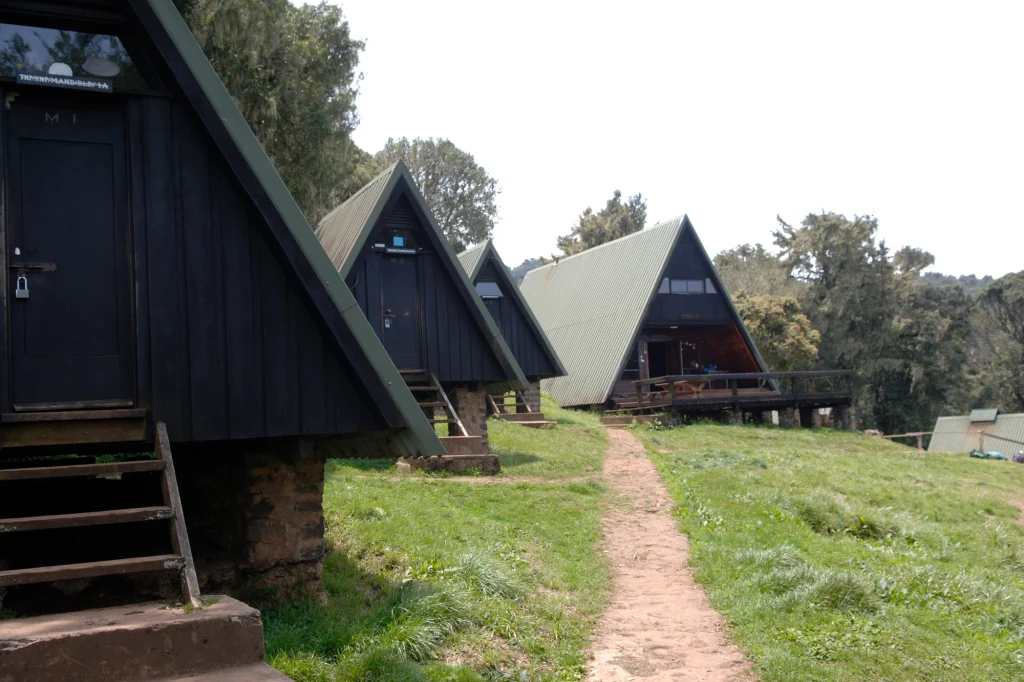
Sleeping arrangements are simple but protected from the weather:
Mandara Hut: a cluster of small A-frame huts near the forest edge
Horombo Hut: a larger hut complex on the moorland, with views of the summit
Kibo Hut: a basic high-altitude hut at the foot of the summit cone
Beds are bunks in shared dormitory rooms, and you may share a room with climbers from other groups.
There are no hot showers on the mountain, and facilities get more basic as you climb. Bring a warm sleeping bag, since the huts are unheated.
Marangu Route vs Other Kilimanjaro Routes
| Factor | Marangu | Machame | Lemosho |
|---|---|---|---|
| Accommodation | Huts | Camping | Camping |
| Typical duration | 5-6 days | 6-7 days | 7-8 days |
| Scenery | Good, forest and moorland | Very good, more varied | Excellent, remote approach |
| Crowds | Busy | Very busy | Quieter |
| Acclimatization | Limited on 5-day, better on 6-day | Good | Best of the three |
| Best for | Hut preference | Popular all-rounder | Highest summit success |
Is the Marangu Route Easy?
Marangu has a reputation as the “easiest” route because the trail is gradual and you sleep in huts. In reality, altitude is the challenge on every Kilimanjaro route, and a short schedule gives your body less time to adjust. The 5-day version in particular has a lower success rate than longer routes.
Tips to improve your chances:
- Choose the 6-day itinerary with the extra acclimatization day
- Walk slowly (“pole pole”)
- Drink plenty of water and eat well
- Train with hiking and cardio beforehand
- Climb with guides trained to spot altitude illness
Best Time to Climb the Marangu Route
The dry seasons are the best windows:
- January to mid-March: warm and dry, fewer climbers
- June to October: the most popular period, with clear skies
The rainy seasons (roughly April to May and November) bring wet, slippery trails and poor visibility.
What’s Included in a Marangu Route Package
- Kilimanjaro National Park fees and hut fees
- Licensed mountain guides, assistant guides, porters and cook
- Meals on the mountain
- Airport and hotel transfers
- Pre-climb briefing
- Optional extensions: safari or Zanzibar after the climb at an extra cost
Not included (typical):
Combine the Marangu Route with a Safari or Zanzibar
- Marangu Route + Serengeti or Ngorongoro safari
- Marangu Route + Zanzibar beach holiday
- Mount Meru first, then Marangu for extra acclimatization
frequently Asked Questions
How long is the Marangu Route?
The Marangu Route takes 5 or 6 days. The 6-day option adds an acclimatization day and is recommended.
Does the Marangu Route have huts?
Yes. It is the only Kilimanjaro route where you sleep in huts with bunk beds rather than in tents.
Is the Marangu Route the easiest way up Kilimanjaro?
The trail is gradual, but the short schedule and quick altitude gain make it harder than it looks. Altitude is the main challenge on all routes.
What is the Marangu Route called?
It is often nicknamed the “Coca-Cola route” because it is the oldest and most established path on the mountain.
Which is better, Marangu or Machame?
Marangu suits climbers who prefer huts, while Machame is more scenic and gives better acclimatization, with camping instead of huts.
Can I shower on the Marangu Route?
No. There are no hot showers on the mountain, so bring wet wipes and a change of clothes.
What is the best time to climb Marangu?
January to mid-March and June to October offer the driest conditions.